Federal Reserve Chair Jerome Powell just last week downplayed stagflation fears but Wall Street is growing increasingly uneasy as rising energy prices tied to the Iran War threaten to reignite inflation and jolt the U.S. economy into a recession.
Economists have sharply raised their recession odds in recent days, warning that an oil-driven inflation shock could complicate the Fed’s attempt to balance the risks of higher price pressures and the softening labor market.
Moody’s Analytics in a new note forecasts a near 50% chance of an economic downturn in the next 12 months, far higher than the typical 20% baseline.
Others, as first reported by CNBC March 25, have also lifted their forecasts:
- Wilmington Trust:45%
- Goldman Sachs:30%.
- EY Parthenon:40%, with the caveat that “those odds could rapidly rise in the event of a more prolonged or severe Middle East conflict.”
The concern?
Not just slower growth but that higher oil prices that could feed into broader sticky inflation thus forcing the Fed to keep benchmark interest rates higher for longer.
Note: History has shown us that the initial hit of energy shock passes very quickly into core prices.
“The negative consequences of higher oil prices happen first and fast,” Moody’s Analytics Chief Economist Mark Zandi said.
“I’m concerned recession risks are uncomfortably high and on the rise,” Zandi said. “Recession is a real threat here.”
He and others say a diplomatic resolution to the Iran War that restores oil flows could prevent the worst-case scenario.
“If oil prices stay where they are through the second quarter, that’ll push us into a recession,” Zandi added.
What the Fed dual mandate requires
The Fed’s dual congressional mandate requires it to balance full employment and price stability.
- Lower interest rates support hiring but can fuel inflation.
- Higher rates cool prices but can weaken the job market.
The two goals often conflict, operate on different timelines and are influenced by unpredictable global events like pandemics and wars.
Fed cites inflation risk from Iran War
Even before the outbreak of the Iran War, the Fed faced a dilemma from worrisome risks to both sides of its congressional mandate: higher unemployment rates and sticky inflation from tariffs.
More Fed:
- J.P. Morgan pushes back on Fed’s 2026 rate-cut forecast
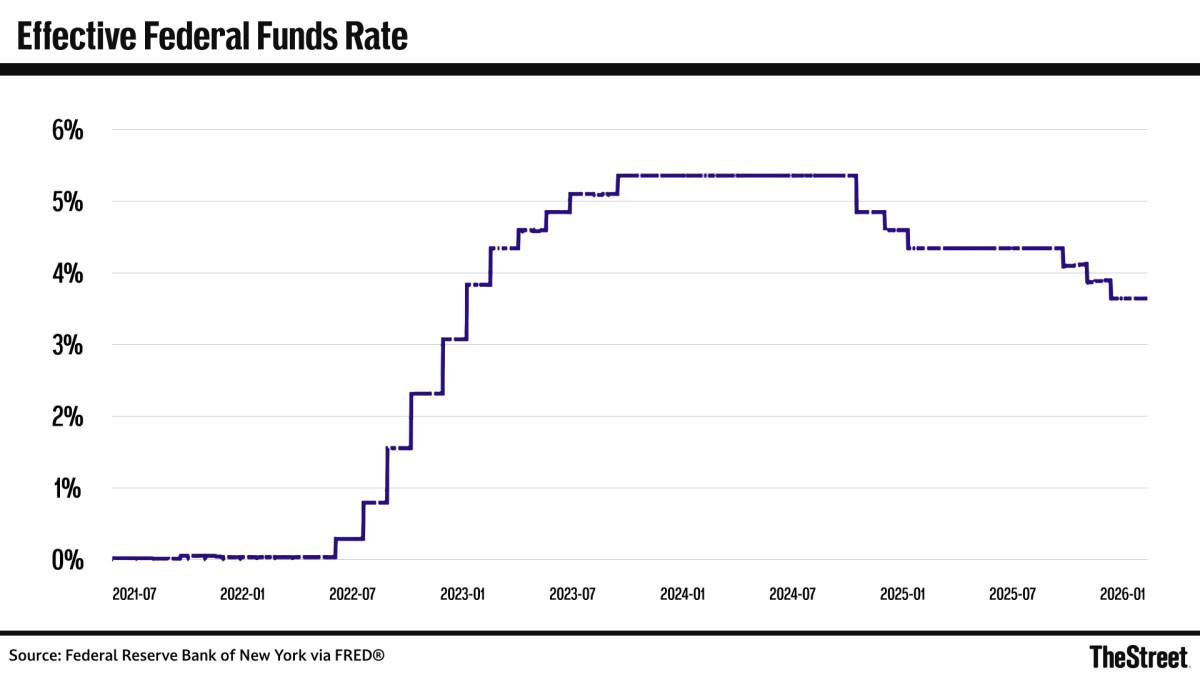
The Federal Reserve’s 11-1 vote on March 18 to hold the benchmark Federal Funds Rate steady at 3.50% to 3.75% underscores the central tension now driving U.S. monetary policy.
Investors are no longer debating whether risks to the Fed’s dual mandate exist but which risk matters more to the U.S. economy.
Federal Reserve Bank of New York via FRED®
Powell pushes back on stagflation concerns
The Iran War, by driving energy costs sharply higher, has reopened the traditional stagflation dilemma of rising prices with slowing growth.
In its March 18 statement, the Federal Open Market Committee said “uncertainty about the economic outlook remains elevated” because the “implications of developments in the Middle East for the U.S. economy.’’
The expected increase in inflation and lower growth from the oil shock has prompted calls of stagflation threats, which conjures up the dreaded 1970s economy that took years to rebound.
As I reported, Powell told reporters after the March 18 FOMC meeting that he didn’t see any current signs of stagflation.
The Fed Chair said the U.S. economy “is doing a good job,’’ despite the many challenges. Comparisons to the 1970s debacle were erroneous, Powell insisted.
“I would reserve the term stagflation for a much more serious set of circumstances,” he said. “That is not the situation we’re in.”
“I always have to point out that that was a 1970s term at a time when unemployment was in double figures, and inflation was really high,” Powell said. “That’s not the case right now.”
Fed’s 2026 forecast on interest rates unchanged
The Fed’s March median Summary of Economic Projections or “dot plot” calls for a single 25 basis point rate cut in 2026, and an additional 25 basis point cut in 2027, the same as the December 2025 forecast.
Related: Morgan Stanley issues stark warning on Fed rate outlook
But Powell noted in his press conference that the rate cut was not guaranteed, especially if the projected decrease in inflation doesn’t occur.
“While the Fed didn’t take rate cuts completely off the table, the rates market did,’’ Morgan Stanley wrote in a recent note. “Powell’s focus on inflation risk and similar concerns from other central banks this past week to bond market pricing to a 40% chance of a Fed rate hike by October.”
Labor-market risk adds to economic concerns
Beyond energy prices, economists say the labor market is a key pressure point.
The U.S. economy created just 116,000 jobs for all of 2025 and lost 92,000 in February.
While the unemployment rate has held steady at 4.4%, that’s largely been because of what’s known as the “no hire, no fire” trend in which employers aren’t hiring but also not firing staff.
Excluding the robust gains in healthcare-related fields — more than 700,000 in all — payrolls outside those areas declined by more than half a million over the past year.
“I think there’s much less inflation risk than [Fed officials] think, and more risk to the labor market to the downside than they stated,” Luke Tilley, chief economist at Wilmington Trust, said.
Dan North, senior U.S. economist at Allianz, said the aging U.S. population will increase the need for healthcare jobs in the future.
“The demand for those jobs is going to be there,’’ North said. “But it’s no way to run a railroad if you’re doing it on one engine.”
Fed’s Waller urges caution on war impact
Federal Reserve Governor Christopher Waller said he would support interest-rate cuts later this year if the labor market continued to weaken.
But he also warned in a CNBC interview March 20 that energy supply disruptions from the Iran War could stoke inflation, which he had expected to decline this year as the impact of President Donald Trump’s tariffs faded.
“Caution is warranted,” Waller said. “It doesn’t mean that I’m going to stay put for the rest of the year. I just want to wait and see where this goes.”
Sustained Iran War heightens recession risk
For investors, consumers and policymakers, the economic path forward appears to be narrowing its options as the Iran War continues.
If energy prices — by the barrel and at the gas pump — remain elevated and begin fueling higher inflation across multiple sectors, then the Fed’s interest-rate pause may continue even if the labor market weakens.
This tension raises the risk of a monetary policy mistake, leaving the U.S. economy — facing increasingly polarized midterm elections — vulnerable to both recessionary and persistent inflationary pressures.
Related: Goldman Sachs resets recession risks for 2026
